Pages

Tuesday, 11 September 2012

Wool


‘Pass by the synthetic department, then, with your nose in the air’
Elizabeth Zimmermann 1972

Words from Elizabeth Zimmermann ‘A Knitters Almanac’.  Her patterns are classics and any one of her sweaters would be the warmest thing to wear on a winter’s walk with the dog or an evening in a chilly old house.  But I go to her books more for the joy of reading her prose and following her instructions for a specific technique (like grafting the toe of a sock) than making the signature sweater for the season.  However, I whole heartedly agree with EZ about wool and its supremacy as a fibre to knit with.  


I know there is a trend to use the more correct term yarn but wool is as much the generic word for yarn-you-knit-with as biro is for ball point pen.  The shops where we buy yarn are Wool Shops, even when in truth they sell every fibre known to woman (or increasingly man)

When you are going to spend six weeks of love and woman hours on  knitting a sweater, what is the point using the cheap stuff made up into a £9.99 jumper available in so many town centre stores? Surely not when there is such a choice of natural fibres available, the emperor of which has to be wool.


Keeping warm under a wrap of wool is the oldest form of clothing (I don’t count the leaves Adam and Eve wove, which had an altogether different purpose).  There is evidence of wool clothing being worn in Britain in 1,900 BCE (the bronze age) and of wild sheep being domesticated in other parts of the world in 10,000BCE.  Today we know that the finest wool comes from the sheep that live in the harshest conditions.  Sheep from the soft southern uplands provide good wool for strong durable cloth, but in the Shetland isles the wool is so fine it can be combed from the back of the sheep before being spun and knit into something so fine it can be drawn through the centre of a wedding ring

How did it all begin? I wonder, would early man have looked sideways as the night grew cold and see the woolly skin of the beast he had just feasted on and pull it over himself before going to sleep?  Or perhaps while burying his forehead into a sheep’s flank while milking would it have occurred to the early farmer that the sheep might have such an abundance of wool that she could share some of that woolly warmth and in no time grow another crop. 

© google images


Over the centuries sheep and wool have been improved, sheep breeding has achieved an animal that only grows the softest wool and wool processing has produced yarn that is superwash, crease free, will pleat at will and is stain and shower proof. But it is still essentially the soft woolly stuff that grows on the backs of the sheep on the hill sides, in every shade of white, through cream to browns and black
  
The Romans brought wool production and wool cloth to Britian but production of fine wool cloth waxed and waned over those early years.  After the Romans left, Britain entered the age of the Anglo Saxons and production declined but by the 8th century woollen cloth was again being exported to the continent and for the next 1000 years never looked back.

The greatest wealth came at first from the export of raw wool.  Where later corn and hay markets would be the centre of local commerce, trading floors that led eventually to the stock exchange, there grew up at the beginning of the second millennium BCE wool markets. 

But in time as wool was grown and processed into yarn then cloth, it was not long before governments saw an opportunity to raise money by taxing and issuing licences

© google images


Another unintended consequence of the wealth created by the wool trade was the effect it had on our religious institutions.  When originally founded monasteries, communities of monks pledged to live in poverty, farmed the land and raised livestock simply in order to feed and clothe themselves with the most basic of necessities.  Although it is no secret that the actions of Henry VIII in dissolving the monasteries was as much to do with acquiring their wealth as to putting an end to their ‘profligate papist life styles’ the abbeys had a problem with money long before that.  A number of socio economic and demographic developments conspired to give the abbots a financial headache. 

There came a time, after more than 600 years of Spartan living in accordance with the Rule of Saint Benedict, when instead of simply having enough sheep for meat or to make the rough woollen monks’ habits the flocks thrived multiplied and the price of wool rose.

It must have been a little like winning the lottery today, what to do with more money than you had ever had before and so much more than needed?  Interestingly like many a lottery winner they built huge houses.  But bound by St Benedict’s rule and their vow of poverty, they built houses for God, including the abbeys of Fountains, Riveaux, Beaulieu and Tintern.  Most are now just hauntingly beautiful ruins, their stones plundered to build the nearby great houses but in the 13th century what must they have seemed like when most buildings were singly storey thatched cottages made of wattle and daub?  Would people have marvelled and revelled in being able to worship in such magnificent buildings raised to the glory of God or would they (much as modern day folk will deride the lottery winner for his house with saunas, two bathrooms per bedroom and an indoor pool) think such a display of wealth was just rather vulgar?

© google images


But there was also another similarity between the Abbots of the 15th century and many today who suddenly come into great wealth.  They used their money for good, building hospitals and hostels, providing a place where the population could come to for help, medicine, shelter and solace. 

The trade in wool transformed the fortunes of whole countries, not just abbeys and monasteries.  It wasn’t just monasteries that got rich on wool.  From the reign of King Edward III until it was damaged in the bombing of the second world war The Lord Chancellor sat on a sack of English wool to remind him (and all the country’s rulers) that the nation’s wealth was once founded on the wool trade.  After the war the sack was remade using wool from flocks of sheep all around the commonwealth.  In 2006 when the role of Lord Chancellor was divided into two the wool sack became the seat of the Lord Speaker.

xx

C


Tuesday, 4 September 2012

Aide Memoire

Two weeks ago sitting alone at a table of a small restaurant in a Corfu side street I sent The Famous Writer a single word text 'Temptress'  accompanied by a wonky photograph. What can it be when one woman sends such a message to another? When alone women talk of many things, of books and ideas, of men and family, dieting and face-lifts  all of which have their temptations but when it comes to leading  another astray, to excess,extravagance, (what you will) I'm prepared to guess shopping for oneself is at the top of a woman's list. And so it was, I had bought this


We had seen the necklace on our outward journey, a long lunch hour spent seeking shade in the alleys of Corfu town, in the time between our plane from Gatwick landing and our departure for the tiny island of Paxos,  I had tried it on, reluctantly relinquishing it to the lovely shop keeper who didn't mind how long we lingered and longed after his jewellery but only bought postcards (themselves things of beauty, black and white images of 1950s Greece).  But when on my return journey I had nearly a whole day before my flight I succumbed.  Thus my text message.  And this rather unflattering photograph


TFW had employed all her writerly skills to persuade me to buy (all by text) 'the stones are precisely your colours', 'they will remind you of Greece during cold grey winter days', 'the shop keeper is so nice...'  How could I not buy?


It has sea blues and greens


 Milky stones as pale as the early morning light through my bedroom window at TFW's house


Jewel colours of the trinkets in the tourist shops


 Amber like the setting sun through the olive trees in the garden and


 pearls as white as the sun bleached pebbles on the beach

And in a way that only our good friends know they are 'my colours' and the colours of the clothes I make and wear, like my girly top


and my sorbetto blouse


But perhaps most telling of all is what is actually in my stash, blues, greens and wine red


Colours all around me  and memories of the alleys and back streets of Greece


How could I not love it?

xx

c

Thursday, 30 August 2012

Sticky challenges


Not a bowl of glossy orange compote but a candle.  A little wobbly (I think the proper term is organic) perhaps but I made it myself and it pleases me.

A little while ago Laura from Homecrafts  e mailed me to ask if I would like to take part in a competition.  The website would send me and several other bloggers a mystery parcel, I would make something with the contents, blog about it and the winner receive a voucher to spend on the site.

Now, I’m a suspicious lawyer, trained to look gift horses right in the teeth so I needed to ask some questions.  Was the mystery parcel free?  Would I be signing up to receive more parcels which weren’t free?  You know, questions like this.  Well no it wasn’t a trick, but my caution meant that I missed the ‘mystery parcel’ that Karen thought would be ideal for me – a packet of miscellaneous woolly fibres and some sari yarn.  But she signed me up for the next competition

The parcel arrived while I was away – candle making materials, wax, wicks, colouring and candle crayons,  a small example of the many things that can be found on the website


I've done simple candle stuff in the past, melting and pouring into cups and dishes but never anything complicated, a BIG challenge then.  After thinking about it for a couple of days I decided to make three sorts of candles.  Beginning with a variation on what I had made before, candles in some of my pressed glass dishes, then some with simple straight sides and some with texture, decorated with the ‘candle crayons’.  Apart from the pressed glass the other containers came from plastic drinks bottles.


To make it easier to get the moulded candles out of the bottle moulds I split them and stuck them back together with masking tape.  Neat eh?


I bought a cheap jug to melt the wax in over a pan of simmering water


And now I shall draw a veil over proceedings.  This is the last tidy picture, you see...  

The jug was a messy pourer
I needed several jugs to mix colours – all available pyrex drafted into action
The tidily stuck together seams in the moulds leaked
I didn’t notice the leaks till orange wax cascaded off the edge of the kitchen work top and onto the floor
My carefully placed flowers, stuck to the side of the moulds with a little wax, floated off and sunk to the bottom

I eventually achieved wax stability by chilling the moulds and adding wax in layers (although this gave me a new opportunity to spill wax all over the place as I tried the run the hot wax up the sides of wobbly plastic bottles with sticky masking tape hanging off in all directions!)

I made 7 candles in all with varying levels of success.  I love the dishes of fruity flowery prettiness. 


The flowers pressed into the sides of the cylindrical candles don’t look as they did in my imagination but I like the effect.  


The candle wax if poured in one go sets to glossy perfection.  Unfortunately I can’t show you that, as the most perfect glossiness was stuck to the kitchen floor and it is lost a little when poured in layers as I did here but if you use one of the proper moulds that Homecrafts sell you would get exactly that


Lastly there is the textured candle with extra embellishment.  Least said about this the better really except perhaps ‘don’t run before you can walk’ and ‘less is more’.  I cannot blame the fact that the instructions on the crayons were only in French, they are short and clear and I understood them perfectly well


I could write a long list of how to make perfect candles, lessons learned and all that but I suspect you can work that out from where I went wrong, but it was all good fun.  Thank you Laura and Homecrafts


xx

c


Thursday, 16 August 2012

Take-away knitting

I'm packing for 7 blissful days away and have one more item to consider for my carry on bag.


I realise the choice of knitting to take to a Greek island is not everyone's priority.  Most people will decide on how much factor 8 to take and whether factor 30 should be used for the face, how many pairs of flip-flops and which bathing costumes (is this the year I finally ditch the bikini?) But for a holiday with a dear friend that you just do not see nearly enough of, knitting is perfect.  As long as I choose something without a complicated pattern, knitting and chatting (as every knitter knows) is the perfect combination.

So, its going to be hot, fine cotton is far better than wool, a simple sleeveless top could be finished in the week and short wooden needles do not upset the security system.

I chose to make Gretel by Julie Weisenberger  in charcoal Habu Cotton Gima - perfect!  The pattern is readily available on line, I found the yarn in exactly the colour I wanted and I have the right size Knit Pro interchangeables

But I don't have the yarn.  I ordered it last week, Thursday to be precise and paid extra to have it posted first class but it has not turned up and I am off to the airport long before the next post arrives.  I haven't received a reply to my two  polite e mails either.  Well the first was very polite, the second a little more complainey - I suggested they should refund the cost of postage at least (first class was £3, whereas second class was free)

I wonder if anyone else has had problems with on line orders?  I order quite a lot of yarn on line and this is the longest I have ever had to wait.

Of course I could (and probably should) have gone to my local yarn shop but they don't have Habu, few places do.  But they do have Noro and yesterday I fished these six balls of Sekku out of a bargain bin at half price.  But I don't want to knit Gretel with this, I want a cardigan and I have no time to trawl ravelry again, (this time for the perfect cardigan)


So I have swatched and cast on enough stitches for fronts and back in one will knit 3 inches of rib and stocking stitch up to the armholes.  I will find a pattern for all the shaping when I get home


I reckon what with all those other Greek island things to do apart from knitting and chatting (like swimming a bit, dozing a lot and eating at the beach pizzeria) this will be quite enough to do.

x

C

Wednesday, 8 August 2012

Knit-along rewards

Although yesterday was my birthday and  nearly all the post that arrived at our house was for me, today was a very exciting post day too


(Do you see the customs label)

Its my prize from the BlightKAL (Organised by Karen of Ridiculous Knits) all the way from the USA.  Beautiful hand painted yarn from Punita Yarns


I already have the other half of my prize, the pattern for Pine Barrens from Deborah Frank, I'm longing to get teh skeins would and begin.

When I last blogged about my Blight it was in the embryonic stage (I would have said tadpole but there is a knitting problem with that as it only ends in frogging).   I was so thrilled to finish very late the following Saturday night having knitted like a demon for 7 days!


Unblocked, fuzzy and a little blurred (it was late).  


But after a long soak in Eucalan (the colour of the yarnscape yarn did run a little) and lots of pulling into shape with blocking wires and holding with pins it had grown into  perfectly flat, multiple pointy, leafy, lacy, loveliness


Something like this needed a perfectly plain frock to wear with it - pale green silk twill, with just a touch of frivol, shell buttons in all the colours of the shawl and one more...


xx

C


Tuesday, 31 July 2012

Wearable vintage

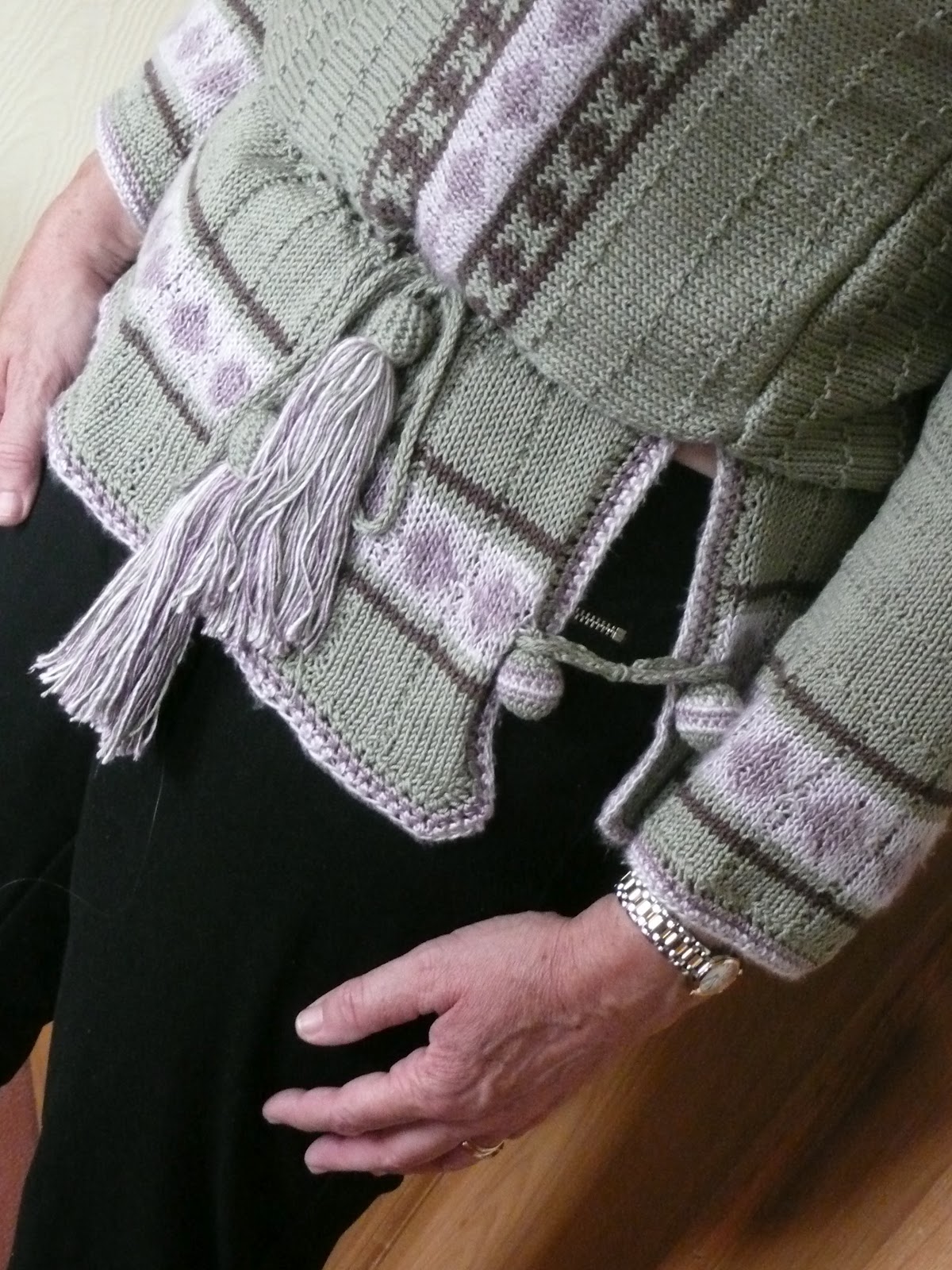
I began making this sweater just for fun, a challenge to myself to see if I could knit something from a photograph.  This photograph


Oh no! not this one... this one is mine - three months of thinking, planning, writing notes and crossing out
and I got there -

from here...


via here...


I have simplified it, by knitting the main body sideways from cuff to cuff via the front and back I could knit the colour work panels fair-isle fashion and not as intarsia, much quicker.

The finished piece was HUGE and took over half the dining-room floor when I blocked it. Sewing up took ages too.  Does anyone else use safety pins for this?  It made it much easier to keep the lines matched up


All the little crochet detail were interesting too.  The fillets at the shoulders allowed for some fullness rather in the same way as one gets from a shirt with a yoke


And I loved the bobble buttons


and the tassells


Loved making them too


When I joined the Titanic sewing project the choice of patterns was wonderful but when I looked around there are far less things to knit.  Hats gloves and mufflers a-plenty, baby things too but not actual items of women's clothing.  Perhaps knitting was mainly confined to shawls and working men's sweaters.  So I was thrilled to find this which is spot on for the period.  Spot on for the style too.  I realise that many of the women in steerage would have kept themselves warm with a shawl but the patterns we are making up are more of the style of the 2nd class passengers and although this tunic is probably designed by Poiret, someone who would have dressed the first class passengers, I see no reason why a 2nd class passenger who was able to knit could not also copy.

My mannequin, still decked out in 1912 blouse, skirt and underpinnings wears the tunic well.


I too shall wear it, with something more modern such as a pair of straight legged jeans


The pattern I devised is available as a Ravelry down load if you would like to make one too.  If you do please let me know - I would love to see other versions

xx

c